
Booking a corporate airport transfer should be straightforward. You need a vehicle, a driver, and a confirmed pickup time. But ask any experienced PA or travel manager and they will tell you that the vehicle choice matters far more than most people realise — and getting it wrong can be costly, embarrassing, or both.
The wrong vehicle creates friction before your executive has even boarded their flight. Too small and there is a scramble for luggage space. Too casual and the impression made on an important client is undermined before the meeting has begun. Too large for a solo traveller and the cost is simply unnecessary.
This guide is written specifically for PAs, executive assistants, travel managers, and anyone responsible for booking corporate airport transfers in London. By the end you will know exactly which vehicle to book for every scenario, and why.
Why Vehicle Choice Matters in Corporate Travel
In a business context, every touchpoint communicates something about your company. The car that picks up your CEO from Heathrow, the vehicle waiting outside the hotel for your international client, the transfer arranged for your senior team flying out for a roadshow — all of these reflect on the professionalism, attention to detail, and standards of the business behind them.
A cramped Economy car where three colleagues sit in discomfort with bags on laps for forty minutes is a poor start to any business trip. A premium executive vehicle where passengers arrive relaxed, on time, and in a calm frame of mind sets an entirely different tone.
This is not about extravagance. It is about matching the vehicle to the occasion, the passenger, and the purpose — and doing so consistently every time.
Understanding the RydeLynk Fleet
Before making a vehicle recommendation for each scenario, it helps to understand what each class in the fleet actually offers.
Economy — Toyota Prius or similar Up to 4 passengers, 2 suitcases, 2 hand carry bags. Hybrid vehicle, clean and professional, ideal for solo or paired travellers with standard luggage. Perfectly suited to routine business travel where comfort is valued but premium presentation is not essential.
Comfort — Volkswagen Passat GTE or similar Up to 4 passengers, 2 suitcases, 2 hand carry bags. Plug-in hybrid with a spacious, comfortable cabin. Noticeably better ride quality than Economy and a step up in presentation. Good for important but not VIP-level transfers.
Estate — Skoda Octavia Estate or similar Up to 4 passengers, 3 suitcases, 3 hand carry bags. The same passenger capacity as Economy and Comfort but with a significantly larger boot. The right choice when luggage volume is the primary concern.
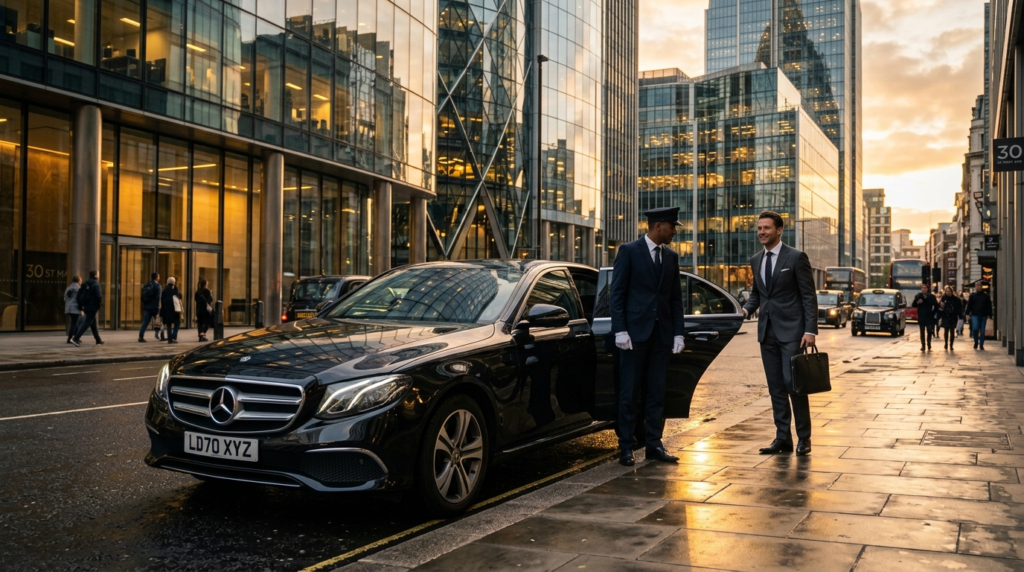
Executive — Mercedes-Benz E-Class or similar Up to 4 passengers, 2 suitcases, 2 hand carry bags. Premium leather interior, superior ride quality, climate control, and the vehicle presentation expected at the highest levels of corporate travel. Available with in-car Wi-Fi. The benchmark choice for senior executives, C-suite travel, and client-facing transfers.
XL — Volkswagen Sharan or similar Up to 6 passengers, 4 suitcases, 4 hand carry bags. A spacious seven-seat MPV suited to small groups travelling together. Practical, comfortable, and cost-effective compared to booking multiple smaller vehicles.
Executive MPV — Mercedes-Benz Vito or similar Up to 8 passengers, 6 suitcases, 4 hand carry bags. Premium captain seats, in-car Wi-Fi, and a level of group travel comfort that matches the Executive class for individual passengers. The definitive choice for corporate group transfers, client collection, and board-level group travel.
Matching the Vehicle to the Scenario
This is where most booking mistakes happen. Here is a clear guide to the most common corporate transfer scenarios and the right vehicle for each.
Scenario 1: Solo Executive, Domestic or Short-Haul Flight
A senior manager travelling alone to a European conference, returning the same day or the following morning. Standard carry-on and a laptop bag.
Recommended vehicle: Comfort or Executive
The Economy class is perfectly functional here, but for senior staff or anyone representing the business externally, the Comfort or Executive class is a small additional cost that delivers a meaningfully better experience. The passenger arrives calmer, more comfortable, and better prepared. For C-suite or board level, always default to Executive.
Scenario 2: Senior Executive, Long-Haul International Departure
A CEO or CFO flying to New York, Singapore, or Dubai for a critical meeting. They have a full suitcase, a suit carrier, and a briefcase. They need to work en route to the airport.
Recommended vehicle: Executive
This is the Executive class in its natural habitat. Premium leather seating, in-car Wi-Fi, a quiet and comfortable cabin, and a driver who understands the importance of discretion and punctuality. The Executive Mercedes-Benz E-Class communicates exactly the right level of professionalism for a senior executive departure. Suit carriers can typically be accommodated in the boot alongside standard luggage — confirm with us at booking if you need specific assurance.
Scenario 3: Collecting an International Client From the Airport
A high-value client is arriving at Heathrow from New York. This is their first visit to your London office and the transfer is their first direct experience of your company’s standards.
Recommended vehicle: Executive
There is only one right answer here. The Executive Mercedes-Benz E-Class, with a meet and greet service in arrivals, a name board, and a professional chauffeur in a pressed suit. The 60 minutes of free waiting time means no pressure on the client to rush through customs, and the fixed price means no awkward conversations about cost. This transfer is a business card in vehicle form.
Scenario 4: Two or Three Colleagues Travelling Together
Three members of the sales team are flying to Edinburgh for a two-day conference. Each has a medium-sized suitcase and a laptop bag.
Recommended vehicle: Comfort or Executive
Three passengers travelling with standard luggage fit comfortably in the Comfort or Executive class. If all three are senior or the trip involves client meetings, book the Executive. If it is an internal team trip, the Comfort class is entirely appropriate and cost-effective. Avoid booking an Economy class for three adults with luggage — the boot space is adequate but the comfort level drops.
Scenario 5: Team of Four or Five, End of Quarter Offsite
Five members of the leadership team are heading to Heathrow for a strategy offsite. Mixed luggage — some with full suitcases, some with cabin bags only.
Recommended vehicle: XL
Five passengers almost always requires the XL Volkswagen Sharan. It seats six comfortably, accommodates four large suitcases plus hand carry, and means the whole team travels together rather than splitting across two vehicles. One booking, one invoice, one pickup point. The cost saving over two separate Executive vehicles is significant and the experience is just as professional.
Scenario 6: Collecting a Group of International Clients
Six clients are arriving from Frankfurt for a two-day site visit. They are all senior, the relationship is important, and they need to feel well looked after from the moment they land.
Recommended vehicle: Executive MPV
The Mercedes-Benz Vito Executive MPV is built for exactly this scenario. Up to eight passengers in premium captain seats, in-car Wi-Fi, and a vehicle presentation that matches the Executive class for individual passengers. A single vehicle for the whole group means everyone travels together, conversations can continue, and the client experience is cohesive from airport to hotel. This is also the more professionally impressive choice over arriving in a standard people carrier.
Scenario 7: PA Booking for Multiple Executives on Different Flights
Three executives are arriving on different flights within two hours of each other. The PA needs to arrange transfers for all three without the company paying for three vehicles sitting idle.
Recommended approach: Three separate bookings, coordinated timing
Book each transfer separately with the correct vehicle class for each passenger. Because RydeLynk tracks flights in real time and provides 60 minutes of free waiting time, each driver adjusts automatically to the passenger’s actual landing time. There is no need for a vehicle to wait two hours for a delayed flight — the driver simply arrives when the flight lands. Coordinate with our team and we can manage the logistics across all three bookings simultaneously.
The Luggage Trap: The Most Common Booking Mistake
The single most frequent error in corporate airport transfer bookings is underestimating luggage. It happens for a straightforward reason — the person making the booking is not the person packing, and nobody mentions the suit carrier, the second bag, or the large presentation materials until the driver has already arrived.
As a general rule, always book one luggage capacity tier above what you think you need. If you expect two suitcases, book for three. If you expect three passengers, confirm their luggage before selecting the vehicle class rather than assuming.
For travel managers handling bookings for multiple travellers across the year, we recommend adding a standard question to your internal travel request process: how many checked bags and how many carry-on items? Two answers eliminate the luggage problem entirely.
The Executive vs Economy Decision: A Framework
Here is a simple framework for deciding between Economy and Executive class on any corporate booking.
Book Executive if the passenger is C-suite, board level, or a named partner. Book Executive if the transfer involves collecting or transporting a client. Book Executive if it is a high-stakes departure — a deal closing, a pitch, an important negotiation. Book Executive if the passenger will need to work or make calls during the journey. Book Executive if the company’s brand standards require a premium presentation.
Book Economy or Comfort if the transfer is internal and routine. Book Economy or Comfort if the passenger specifically prefers simplicity over comfort. Book Economy or Comfort if the journey is short and the vehicle class is unlikely to be noticed.
When in doubt, book up. The difference in cost between Comfort and Executive is rarely significant in the context of a business trip, and the difference in impression can be substantial.
Corporate Accounts: Simplifying the Booking Process
If your business makes regular use of private hire for airport transfers, a corporate account with RydeLynk removes most of the friction from the booking process. You get a dedicated point of contact, simplified booking by phone or email, consolidated invoicing, and a team that learns your preferences over time.
For PAs managing travel for multiple executives, an account relationship also means you are not starting from scratch every time. We know your standards, we know your preferred vehicle classes, and we can turn around a booking confirmation faster than any online form.
To set up a corporate account, contact us directly at support@rydelynk.co.uk or call us on +44 20 8103 0477. We will arrange everything in a single conversation.
A Final Note on Punctuality
In corporate travel, punctuality is not a preference — it is a professional obligation. The vehicle recommendation means nothing if the driver is late, cancels last minute, or cannot be reached on the day.
Every RydeLynk corporate transfer is backed by real-time flight tracking, a guaranteed no-cancellation policy, 60 minutes of free waiting time at airports, and 24/7 support by phone and WhatsApp. The vehicle arrives. The passenger lands. The transfer happens exactly as planned.
That reliability is the foundation everything else is built on — and it is what separates a professional private hire operator from a ride-hailing app.